Pont du Gard: Roman ingenuity standing the test of time
A look back at an ancient aqueduct whose engineering precision continues to astonish two millennia later.
Translation of the original French article. Proposed by AI, reviewed by the author.

Staying in the Gard without visiting the Pont du Gard would have been a shame. So we hit the road toward this ancient bridge, a true architectural feat. Nestled in the heart of preserved garrigue, spanning the calm waters of the Gardon, the silhouette of the structure gradually reveals itself along the path, and the sense of grandeur only grows as one draws closer.
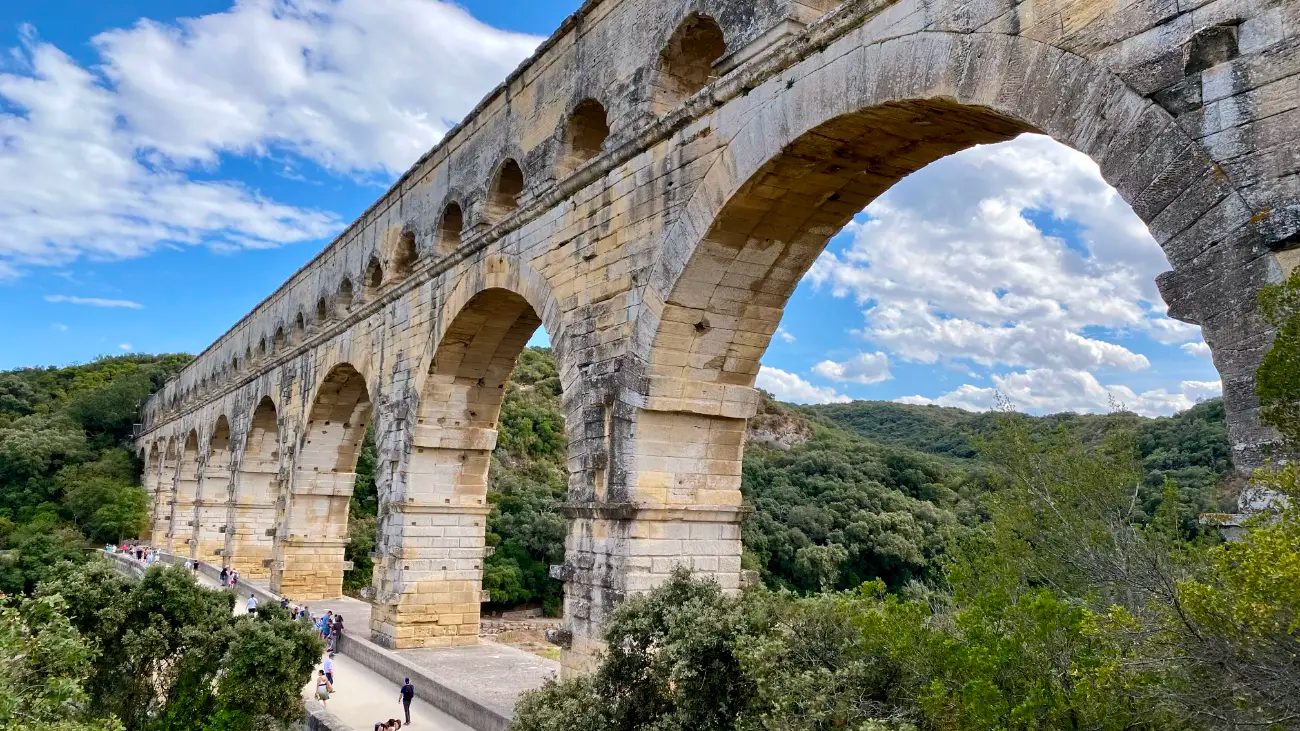
From the very first moments, one grasps just how much this structure, nearly two thousand years old, has managed to defy time: its arches, gilded by the southern French sun, seem as though they were laid there only yesterday, so intact does their harmony remain. A visit that promised as much historical escape as visual pleasure.
A feat of Roman engineering
Contrary to what its name suggests, the Pont du Gard is not truly a bridge, but the monumental section of an aqueduct more than 50 km long. Built by the Romans around 50 AD, this exceptional structure carried water from the Fontaine d'Eure, located at the foot of Uzès, all the way to the city of Nemausus, present-day Nîmes, then at its peak, until the 6th century.
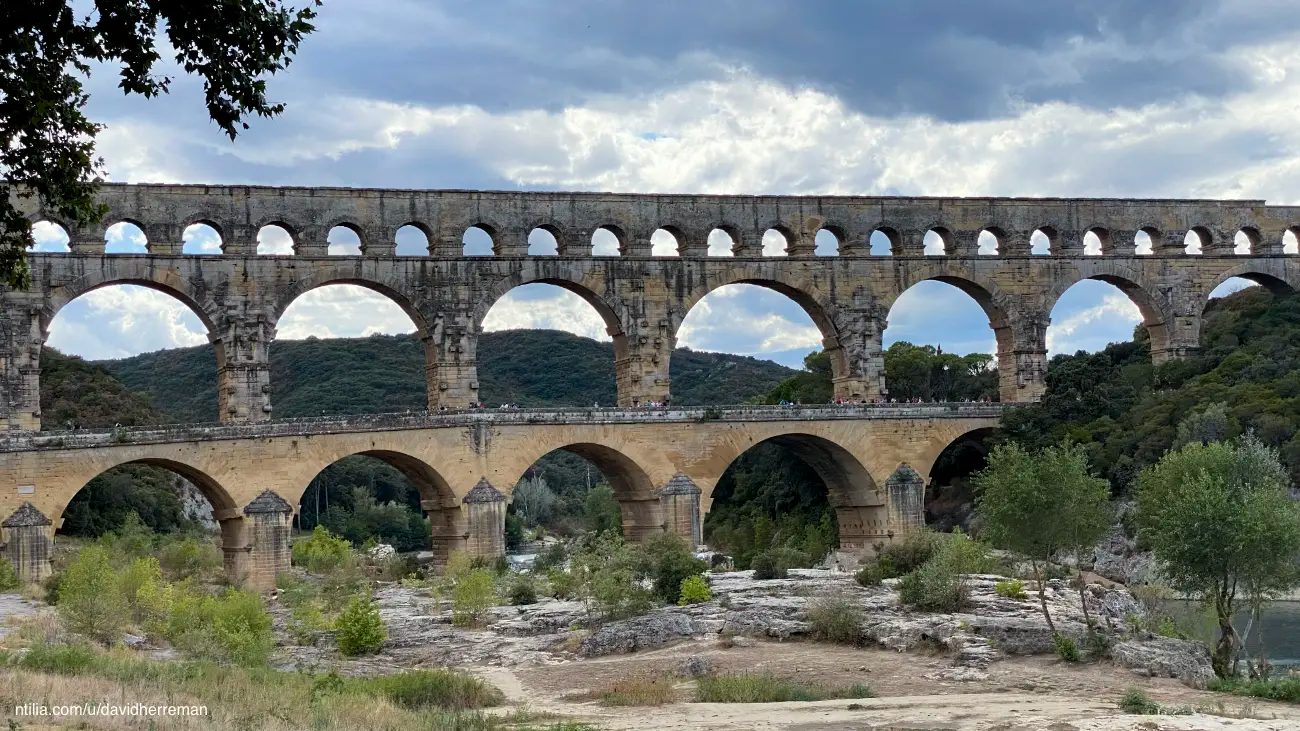
To cross the Gardon valley, Roman engineers had no choice but to erect this three-tiered bridge, the only way to maintain the gentle slope needed for the water flow while spanning above the river. All the stones that make it up were extracted from a quarry only 600 to 700 meters downstream from the monument, on the left bank of the Gardon: a proximity that greatly facilitated the transport of the blocks, some of which weigh several tons.
Over the centuries, the aqueduct gradually lost its original function: for lack of maintenance, limestone deposits ended up clogging the channel, progressively reducing the flow. In the Middle Ages, the structure was partly destroyed so its stones could be recovered and reused in other constructions.
Figures that leave you in awe
At 48.77 meters high, the Pont du Gard held a record for its time: it is the tallest Roman aqueduct bridge ever built. At 273 meters long, it remains today the only example of an ancient three-tiered bridge still standing, with its triple row of superimposed arcades: six arches at the lower level, eleven at the intermediate level, then the upper levels which carried the water channel, protected by a covering of slabs. At each level the arches narrow as one rises, giving the whole structure its characteristic visual balance.
Even more impressive, the average slope of the aqueduct along its 50 km course was only 25 cm per kilometer, that is a total elevation difference of barely 12.6 meters between the source and Nîmes: an astonishing leveling precision for the time, achieved without the instruments we have today.
For nearly five centuries, about 35,000 m³ of water were carried each day by the Uzès-Nîmes aqueduct, to supply the inhabitants, but also the baths, fountains and gardens of the Roman city. At such a flow rate, the water took about 24 to 30 hours to travel the entire route and reach the castellum divisorium of Nîmes, the distribution basin from which pipes ran to the various districts of the city.
Anecdotes and legacy
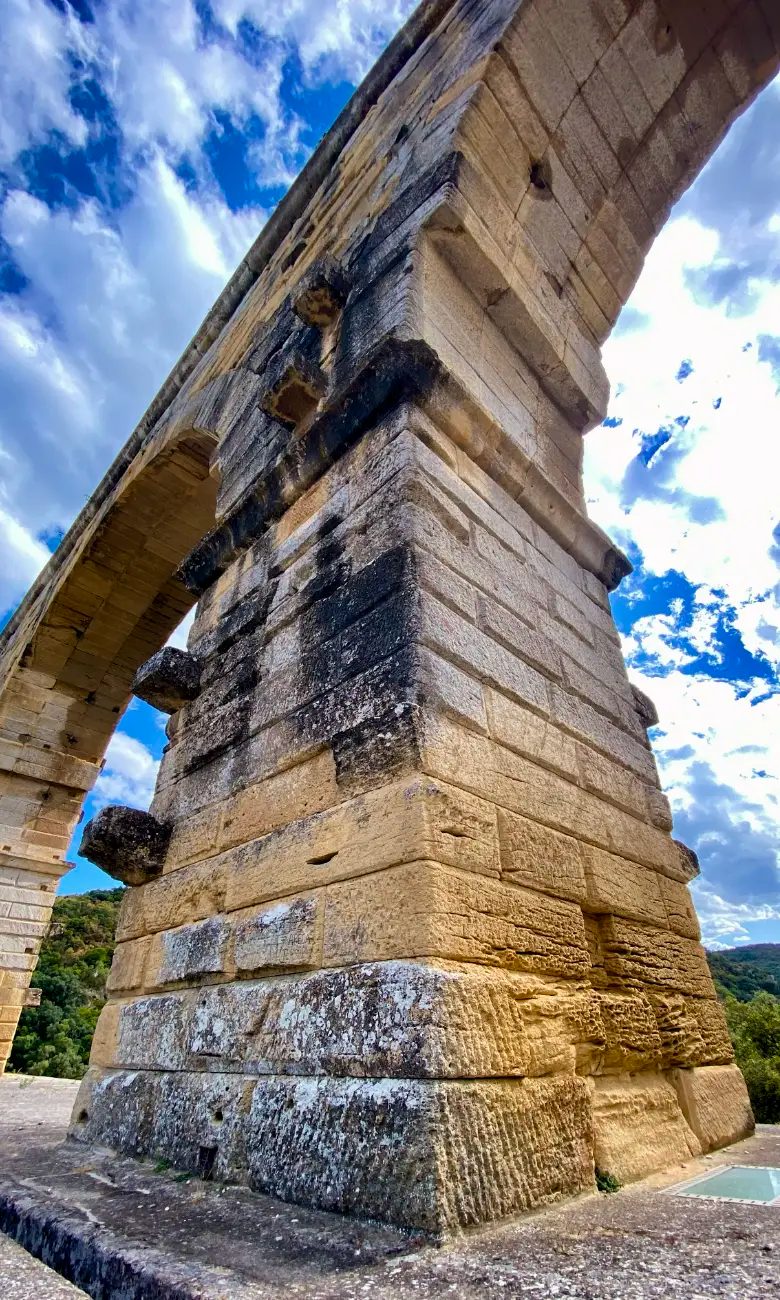
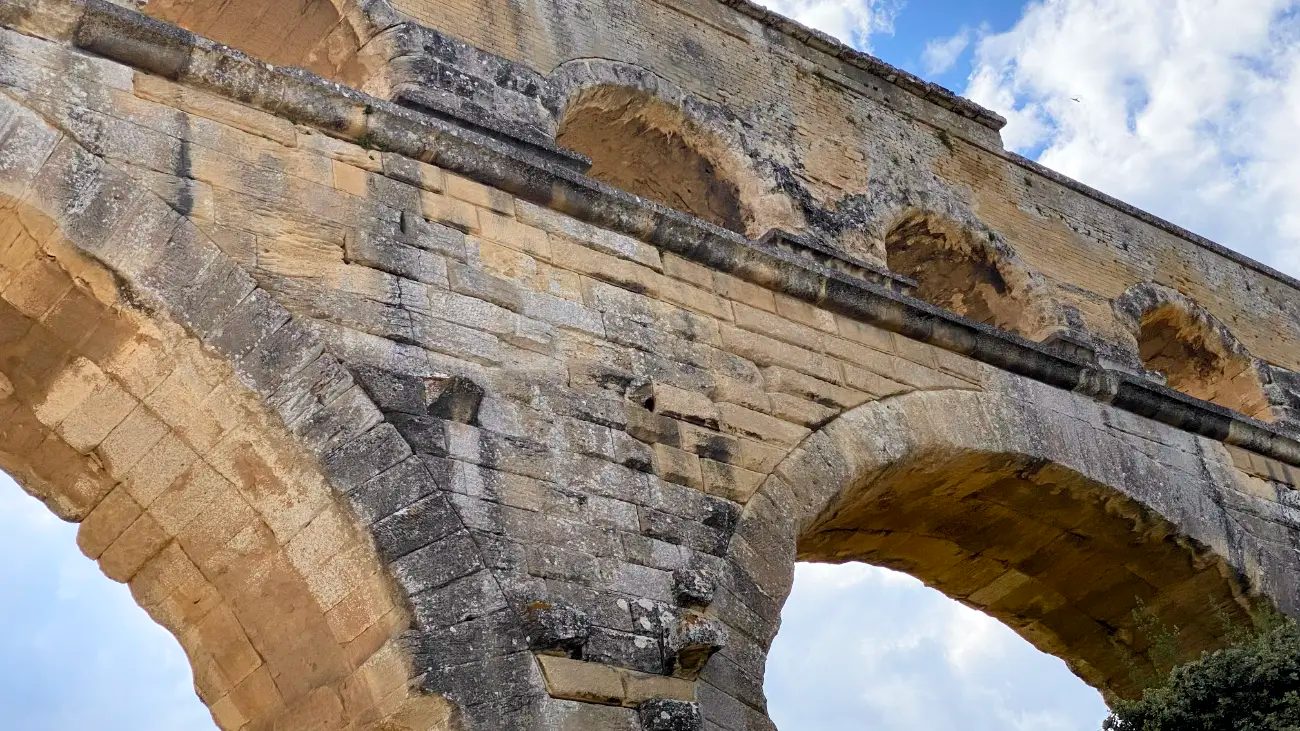
The refinement of the design continues to intrigue historians and archaeologists: the aqueduct's slope was remarkably precise in order to ensure the water's flow over tens of kilometers. The stones, some of which weigh several tons, were assembled without mortar, cut with such precision that they fit together by their weight alone and their perfect fit. On the facings one can still make out the projecting corbels that were used to support the scaffolding during construction, as well as the holes left by the lewises, those metal fittings that allowed the blocks to be hoisted using winches and man-powered wheel cranes. So many details that testify to a construction site methodically designed to do without any binding material.
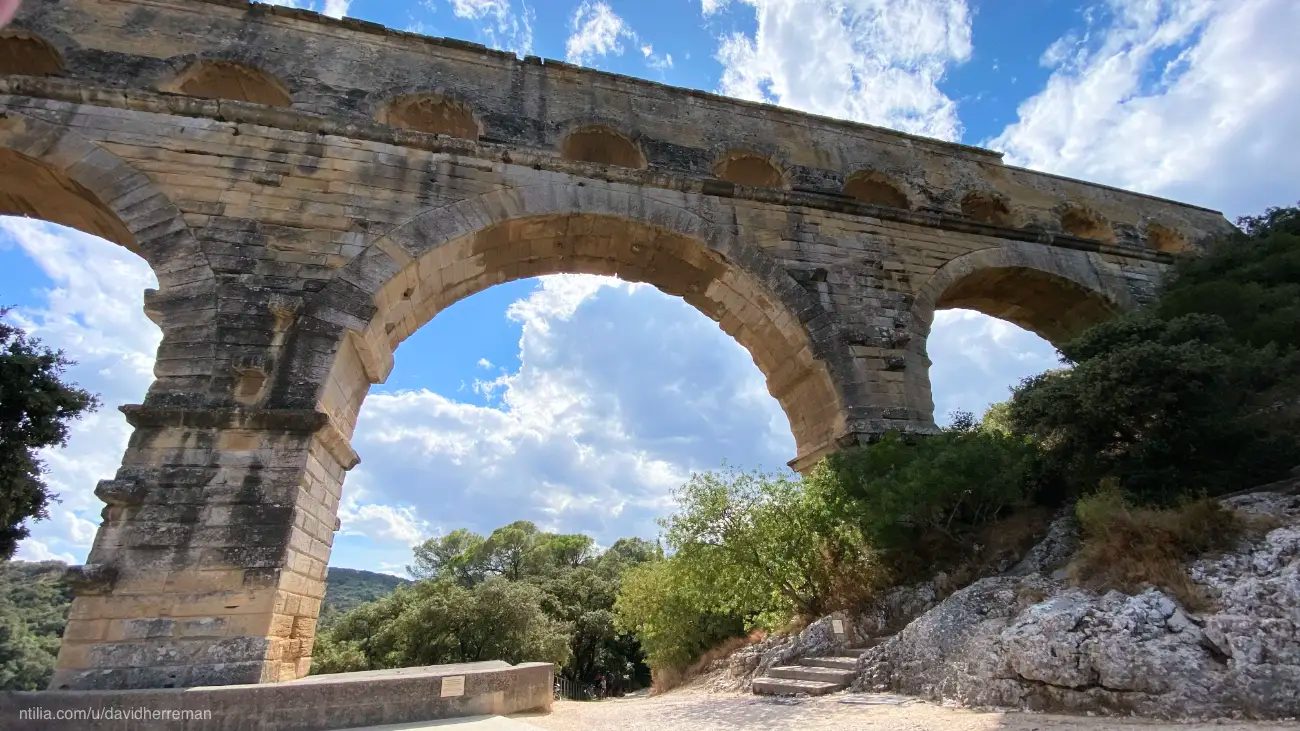
It is also said that the monument owed part of its survival to a much later use: starting in the 18th century, the bridge was fitted out to support a road, which meant it was maintained and reinforced rather than dismantled for its stones. It was also in the 19th century that Napoleon III, passionate about Roman antiquity, commissioned major restoration works that helped preserve it in the remarkable state in which we discover it today.
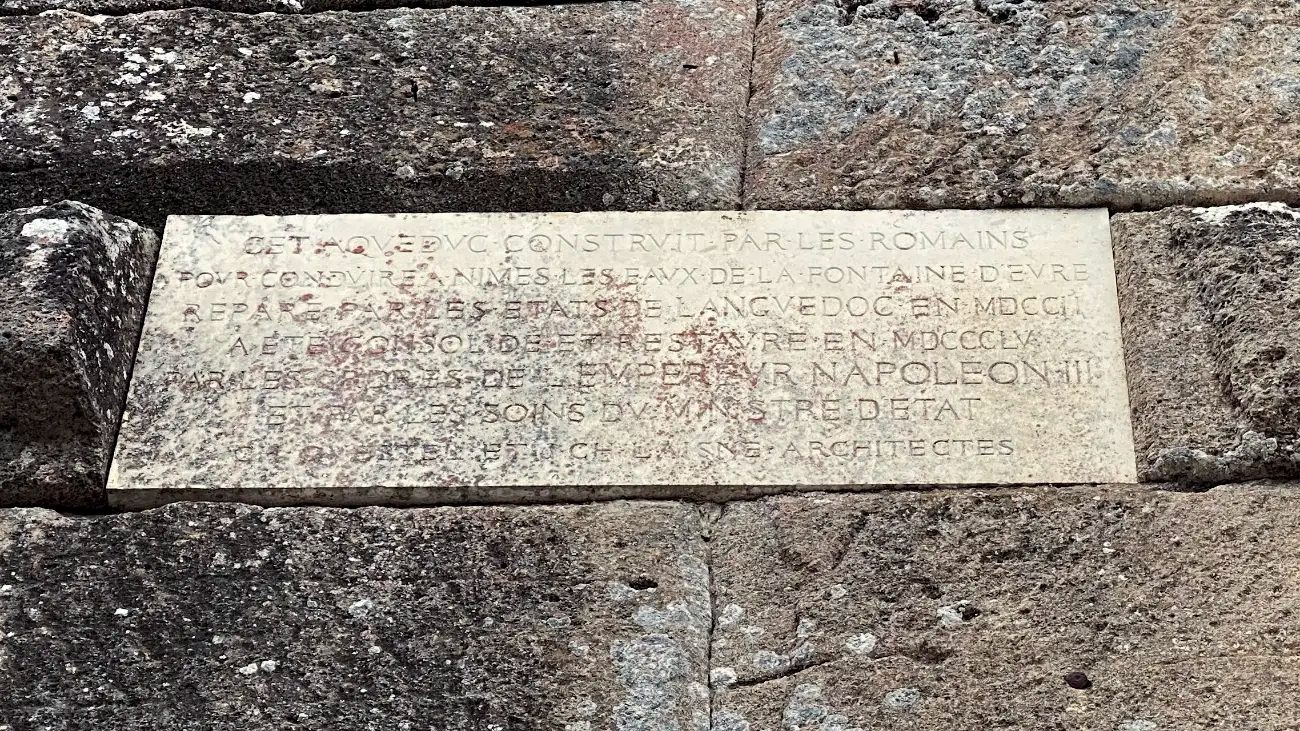
CET AQVEDVC CONSTRVIT PAR LES ROMAINS
POVR CONDVIRE A NIMES LES EAVX DE LA FONTAINE D'EVRE
REPARE PAR LES ETATS DE LANGVEDOC EN MDCCII
A ETE CONSOLIDE ET RESTAVRE EN MDCCCLV
PAR LES ORDRES DE L'EMPEREVR NAPOLEON III
ET PAR LES SOINS DV MINISTRE D'ETAT
C.F. DE BAYER ET H.C. LAISNE ARCHITECTES
In modern French with the dates:
« This aqueduct, built by the Romans to carry the waters of the Fontaine d'Eure to Nîmes, repaired by the Estates of Languedoc in 1702, was consolidated and restored in 1855 by order of Emperor Napoleon III and under the care of the Minister of State. C.F. de Bayer and H.C. Laisne, architects. »
The most visited ancient monument in France, the Pont du Gard has been listed as a UNESCO World Heritage Site since 1985 and remains one of the best-preserved Roman remains in the world, attracting more than a million visitors from around the world each year.
Impressions during the visit
Seeing these stones that have stood there for nearly two thousand years, some of which weigh several tons, leaves an impression of grandeur that is hard to describe. One then measures the full power of Rome in the first century, and can easily imagine the engineering deployed as well as the sheer scale of the undertaking that the construction of such a structure represented.
Beneath the arches, the eye gets lost in the perfect interlocking of blocks assembled without mortar, and it is hard to believe that no modern machine took part in this undertaking. The contrast between the roughness of the stone and the delicacy of the proportions never ceases to strike: as the light changes throughout the day, the ochre and golden hues of the limestone seem to bring the structure back to life.
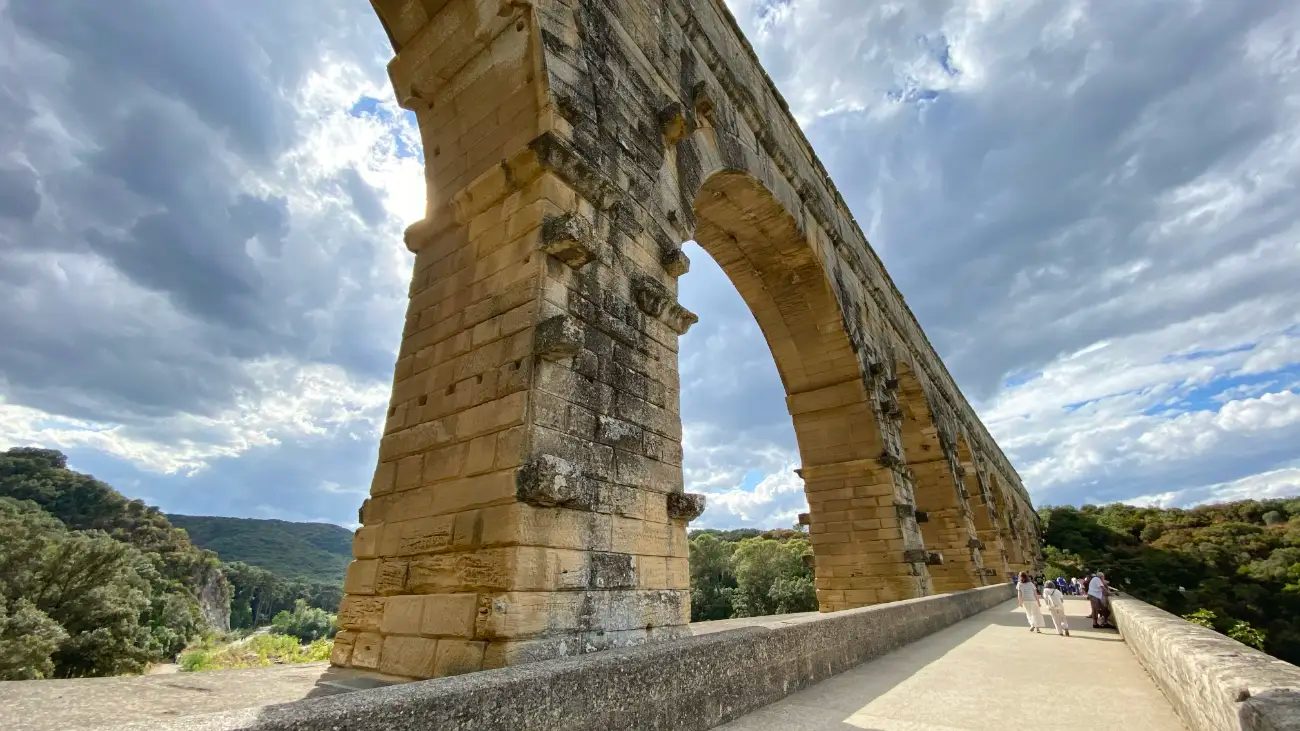
On some stones, one can still make out engravings left over time by visitors from 1850, 1900... Names, dates, initials patiently carved with a knife or chisel, sometimes topped with a place of origin or a profession. So many discreet traces that remind us that generations before us also walked these grounds, seized by the same emotion. Above all, they remind us that we too are only passing through here below, whereas the Pont du Gard, for its part, crosses the centuries unperturbed.
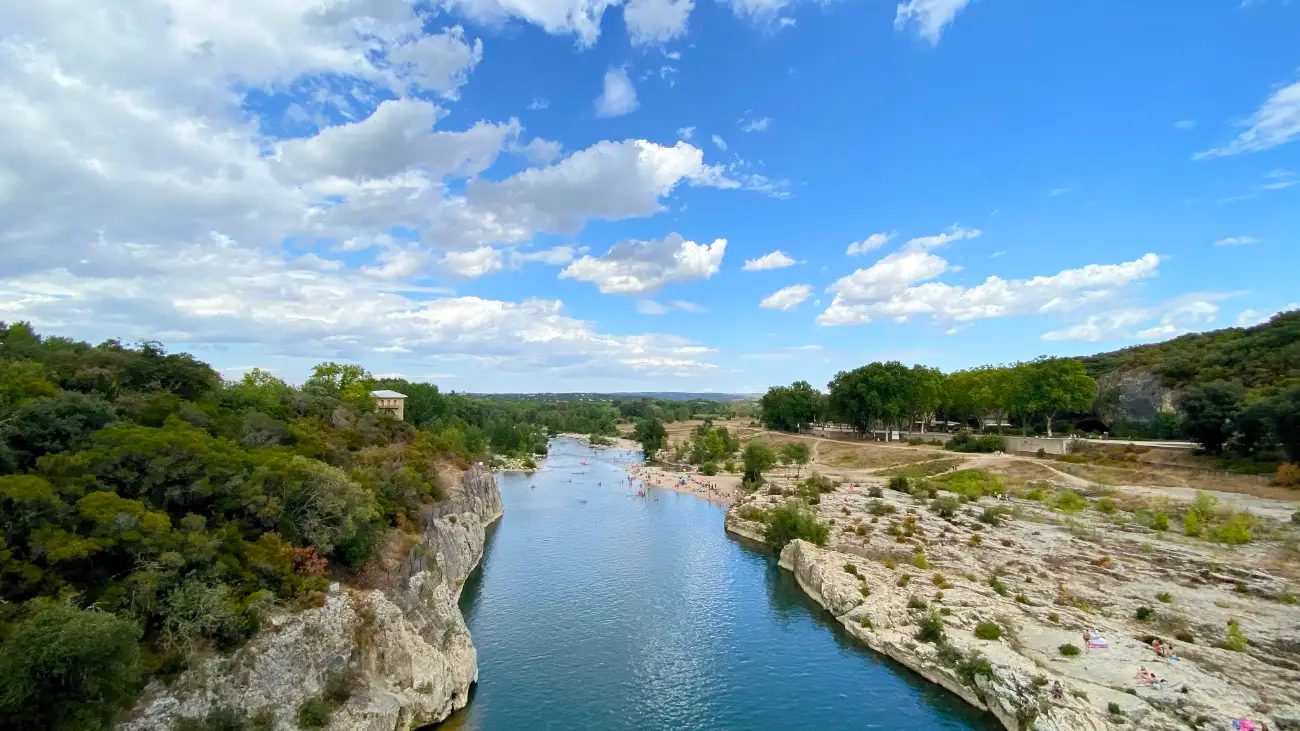
If you find yourself in the area, this visit is truly worth the detour. Indeed, you can take the time to admire the monument from every angle, from both banks as well as from the overlooking paths that offer superb viewpoints. Moreover, in fine weather, it is possible to take lovely walks in the surrounding area, through the garrigue and its typically Mediterranean landscapes, or to enjoy the Gardon: swimming, canoeing or simply pausing by the water allow you to contemplate the structure from the river, in a preserved natural setting. An ideal way to extend the visit and fully enjoy the site throughout the day.
Sources
- Pont du Gard — Wikipedia
- 5 chiffres à retenir sur le Pont du Gard — France.fr
- Le Pont du Gard, joyau romain — Uzès Pont du Gard
- Le Pont du Gard. Histoire et secrets de sa construction — Nemausensis
Frequently asked questions
Is the Pont du Gard really a bridge?
No, contrary to what its name suggests, the Pont du Gard is not truly a bridge but the monumental section of an aqueduct more than 50 km long, built by the Romans around 50 AD.
What was the Pont du Gard aqueduct used for?
The aqueduct carried water from the Fontaine d'Eure, located at the foot of Uzès, all the way to the city of Nemausus (present-day Nîmes), until the 6th century. It transported about 35,000 m³ of water each day to supply the inhabitants, the baths, the fountains and the gardens of the Roman city.
How tall is the Pont du Gard?
The Pont du Gard is 48.77 meters high, making it the tallest Roman aqueduct bridge ever built. At 273 meters long, it remains the only example of an ancient three-tiered bridge still standing.
How were the stones of the Pont du Gard assembled?
The stones, some of which weigh several tons, were assembled without mortar, cut with such precision that they fit together by their weight alone and their perfect fit. They were hoisted using winches and man-powered wheel cranes.
What was the slope of the Uzès-Nîmes aqueduct?
The average slope of the aqueduct along its 50 km course was only 25 cm per kilometer, that is a total elevation difference of barely 12.6 meters between the source and Nîmes, an astonishing leveling precision for the time.
How was the Pont du Gard preserved over the centuries?
Starting in the 18th century, the bridge was fitted out to support a road, which meant it was maintained and reinforced rather than dismantled for its stones. In the 19th century, Napoleon III commissioned major restoration works, in 1855.
Is the Pont du Gard a World Heritage Site?
Yes, the Pont du Gard has been listed as a UNESCO World Heritage Site since 1985. The most visited ancient monument in France, it attracts more than a million visitors from around the world each year.
What activities can you do around the Pont du Gard?
You can admire the monument from both banks as well as from the overlooking paths, take walks through the garrigue and its Mediterranean landscapes, or enjoy the Gardon with swimming, canoeing or a pause by the water.