The Markdown from the field to the public journal
Dictation, editorial AI, and publishing on a clean URL: nTilia supports every step without writing in your place.
Translation of the original French article. Proposed by AI, reviewed by the author.

There are places where the network disappears before the sentence ends. An interview in a courtyard, a mission in a dead zone, a crowded café where Wi‑Fi decides for you. It's often there that the best fragments are born — and there that they get lost in an illegible draft, in the roar of a demonstration, without losing track of the time or the place.
The researcher who dictates observations at the edge of a site, hands full of equipment. The NGO team documenting a mission in a region cut off from the world, relying only on what fits in a pocket. The freelancer juggling three notebooks, two phones, and the anxiety of losing everything at the next update.
These are people who don't have the luxury of a quiet studio and a stable connection. They write standing up, while walking, between two appointments. What they share isn't a common profession, but the same requirement: that the tool fade behind the story, and that ownership of the words never leave their hands.
It's for them that nTilia was designed.
The thread, from start to finish
nTilia can be summed up as a single movement, from chaos to clarity. Capture first, when reality gives no warning. Refine afterward, with a clear head, with help that suggests without deciding. Publish finally, on an address that belongs to you and that respects the reader.
nTilia was born from this gap: a Markdown editor designed for the field, then for the story.
Capture first
The priority is to capture before losing. Voice dictation to speak when writing is impossible — one hand on the notebook, the other holding a microphone. Photo with caption, to anchor a face or a document at the right moment in the story. Location and timestamp attached automatically, because a fragment without context quickly becomes a puzzle three weeks later.
No need to wait for a connection to write. Notes stay local, on your device, available even in a subway tunnel or deep in a valley. Synchronization resumes on its own when the network returns — not the other way around. It's the field that dictates the pace, never the signal bar.
The format stays open: Markdown. Import, ZIP export with notes, audio, and metadata. Nothing to lock into a proprietary silo.
Refine afterward
AI doesn't write in your place behind the scenes. It suggests — spelling, tone, translation, titles, intros — and you validate. A before/after review, visible credits, actions triggered by you.
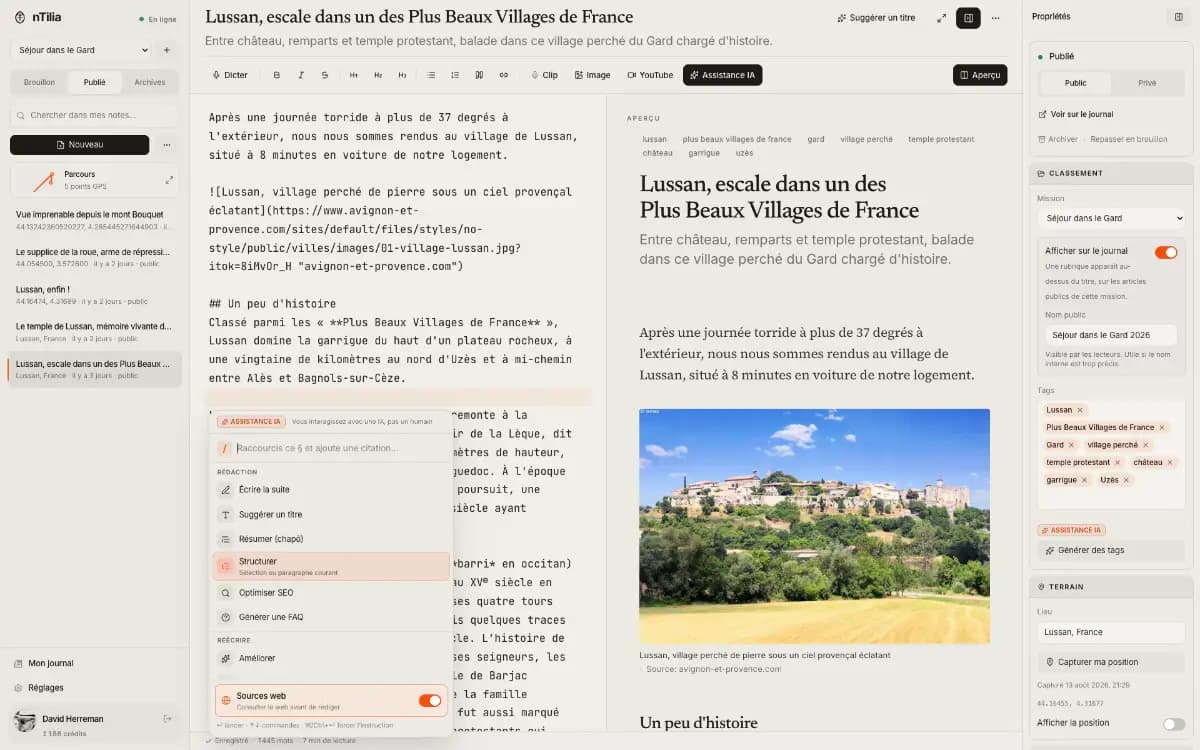
Concretely, nothing moves without a gesture from you. You highlight a paragraph, you choose an action — correct punctuation, tighten a sentence that's too long, translate a quoted passage, suggest three title variants — and the suggestion appears next to the original text. You compare, you accept, you refuse, or you keep only a part. The final word remains yours.
Each call consumes a credit displayed clearly: you know what you're spending before you spend it, with no surprises or silent processing. No automatic rewording applies while your back is turned, no style is imposed on you by default. The tool speeds up the thankless tasks — the typo, the repetition, the clunky phrasing — to leave you time for what matters: the choice of words, the rhythm, the angle.
This is not a generic chatbot. It's an editing aid, in service of a human voice.
Publish a journal
When the text holds up, it can live on a public journal — a clean, readable, shareable URL. Not a noisy feed, saturated with notifications and algorithms that decide in your place: a feed of humanity, where each publication exists on its own. In-depth articles, field notebooks, short reports taken in the moment. From the raw note scribbled in a courtyard to the text ready to circulate, the continuity remains visible — you can feel the path traveled.
The address is stable and sober: no illegible parameters, no opaque redirects. You share a link, it opens your text, with no intermediary or advertising overlay. The reader arrives at your words, not at an attention-grabbing machine.
Each article keeps its original Markdown formatting — titles, quotes, captioned images, links — with no wild reformatting. What you wrote in the field is what displays on screen. The journal becomes a living archive of your work: consultable, citable, exportable if you ever decide to go elsewhere.
Who it's for
Journalists, researchers, NGOs and missions, freelancers. Anyone who writes far from the office and wants to keep control over content, form, and files.
The reporter who notes a source in a courtyard, between two appointments, and doesn't want to lose anything. The researcher gathering field interviews, each dated, located, exportable for later analysis. The NGO whose teams document a mission in a dead zone, far from any reliable connection, and want to produce a clean report upon return. The freelancer or independent who doesn't depend on any newsroom, but insists on publishing under an address that belongs to them.
The common thread: work that begins outdoors, in the unexpected, and must remain readable, verifiable, portable. No silo, no captive format, no platform that claims your texts. You keep the content — your words, your angle —, the form — the Markdown, the layout — and the files — notes, audio, images, metadata, exportable whenever you see fit.
The free plan is enough to get started: editor, journal, AI credits every week, no credit card required. Pro and Pro+ unlock transcription, more volume, and advanced editing options.
Dictate. Refine. Publish.
Try it at ntilia.com — even offline.